Leadership & Organizational Development
Build Capability That Transfers to Performance
HWC designs evidence-informed development strategies, pathways, and experiences that strengthen human capability, leadership capability, team effectiveness, and organizational performance. We connect learning to application so development produces meaningful and sustainable change.
When development support may be valuable
Leadership Expectations Have Changed
Current leaders need expanded capabilities to meet evolving strategic, operational, and people responsibilities.
Promotion Has Outpaced Preparation
Recently promoted leaders need support transitioning from technical expertise to effective people and organizational leadership.
Teams Are Experiencing Friction
Communication breakdowns, limited trust, or weak coordination are affecting alignment, collaboration, and performance.
Learning Is Not Becoming Practice
Development investments are not consistently translating into sustained workplace behavior or measurable performance improvement.
The Leadership Pipeline Is Too Thin
The organization lacks sufficient internal talent prepared for advancement, succession, and critical leadership responsibilities.
Change Requires New Capabilities
Growth, transformation, technology, or workforce shifts require people and leaders to think, work, and lead differently.
Leadership Capability Engineered for Performance When Consequences Matter
Leadership development must do more than build knowledge. It strengthens the capabilities leaders need to perform when expectations are high, conditions are changing, decisions carry consequences, and people and organizational performance depend on how well they lead.
HWC begins with the organization and the work—not with a predetermined training program. We identify what the organization requires, what leaders must be able to do, and the capabilities needed to perform effectively. Development then connects assessment, learning, practice, real-world application, feedback, adaptation, reinforcement, and evaluation so that capability can transfer into the work and contribute to sustained performance.
The greater the consequence of leadership performance, the greater the rigor development deserves.
Development Pathways and Programs
HWC designs development pathways around the organization’s strategy, leadership requirements, workforce conditions, and readiness needs. Representative applications across the leadership continuum include:
Emerging-Leader Development
Prepare high-potential and aspiring leaders for expanded responsibility through self-awareness, communication, judgment, influence, and applied leadership practice.
Frontline-Leadership Development
Equip supervisors and frontline managers to transition from technical contribution to effectively leading people, performance, communication, and accountability.
Middle, Senior, and Executive Leadership Development
Strengthen the strategic judgment, enterprise perspective, influence, adaptability, and organizational leadership required to lead across functions, systems, and consequential change.
Succession and Leadership Pipeline Development
Strengthen leadership continuity by identifying critical roles, clarifying capability requirements, assessing readiness, and creating targeted development pathways.
As a business grows, the capabilities required to lead people and work effectively together often need to grow with it. You may benefit from targeted leadership or team development if:
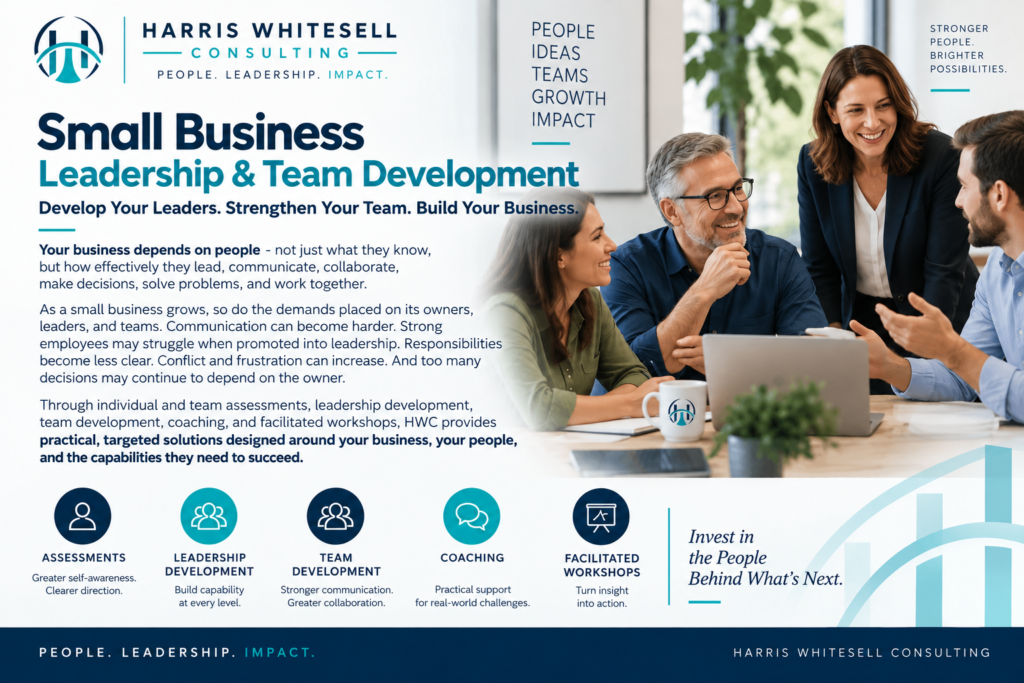
Are You Seeing These Signs in Your Business?
As a business grows, the capabilities required to lead people and work effectively together often need to grow with it. You may benefit from targeted leadership or team development if:

The symptom tells us where to look. The capability helps us determine where to develop.
HWC helps small businesses move beyond the visible challenge to better understand the individual, leadership, interpersonal, team, or organizational capabilities that may be contributing to it. Through assessments, leadership development, team development, coaching, and facilitated workshops, HWC provides practical, targeted solutions designed around your business, your people, and the capabilities they need to succeed.
Employees and managers frequently escalate routine decisions rather than exercising appropriate judgment and ownership.
They know the work, but leading people, delegating, coaching, communicating expectations, or addressing performance requires a different set of capabilities.
Tasks get assigned and deadlines get monitored, but employees receive too little direction, feedback, development, recognition, or support.
Information gets missed, messages are interpreted differently, expectations are unclear, or people discover important decisions too late.
Concerns go unaddressed, feedback is withheld, problems linger, or frustration appears through silence, gossip, defensiveness, or conflict.
Responsibilities may be understood differently, commitments are not always followed through, and leaders find themselves repeatedly reminding or rescuing others.
Individual employees may perform well, yet collaboration, coordination, trust, information sharing, or collective problem-solving remains difficult.
People have difficulty understanding one another’s approaches, intentions, preferences, or ways of communicating and working.
Conversations repeat, decisions remain unresolved, responsibilities are unclear, or agreed-upon actions do not consistently happen.
Interpersonal tension, unresolved disagreements, competing priorities, or strained relationships are consuming energy that should be directed toward the business.
Behaviors and norms that worked when the company was smaller may no longer support the organization it is becoming.
Knowledge, relationships, authority, or decision-making remain concentrated in too few people, creating dependency and limiting organizational capacity.
The business needs future supervisors or leaders, but leadership readiness and development needs have not been systematically assessed.
New customers, employees, locations, responsibilities, or complexity are increasing faster than leadership and team capability.
The immediate symptom may be retention or motivation, while leadership, communication, trust, role clarity, team dynamics, or employee experience may warrant closer examination.
Rather than immediately choosing another training program, an assessment or facilitated diagnostic process can help identify where development may have the greatest value.
From Development Need to Sustainable Capability
HWC connects development to workplace application, measurable progress, and sustained organizational capability.
-
1
Diagnose and Align
Clarify business priorities, performance requirements, organizational context, and capability gaps.
-
2
Design
Create the appropriate development pathway, learning experience, success measures, and reinforcement plan.
-
3
Develop
Build targeted capabilities through facilitation, coaching, practice, reflection, and applied learning.
-
4
Apply and Reinforce
Integrate new capabilities into workplace behavior, leadership practices, team interactions, and performance.
-
5
Evaluate and Sustain
Measure progress, adapt the approach, reinforce successful practices, and strengthen internal capacity.
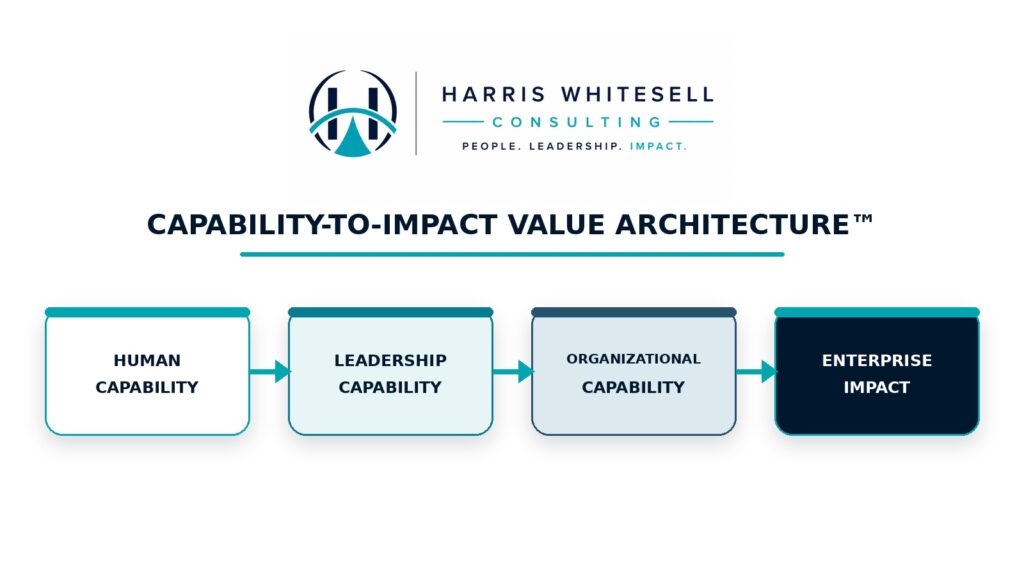
Not every engagement begins or ends at the same point. HWC determines where the material gap exists and designs accordingly.
Workforce Development Partnerships
HWC also works with employers, chambers of commerce, educational institutions, workforce agencies, and professional associations to strengthen workforce and regional capability. These engagements connect employer needs, leadership and human capability, development pathways, partner resources, and measurable outcomes.
Development should begin with the capability the organization needs – not with a predetermined course.