
When the Business Grows, the People System Must Grow with It
How to recognize when leadership team and organizational capability are becoming constraints on growth.
Small business owners know how to watch the numbers: revenue, cash flow, expenses, sales, payroll, customer acquisition, margins, and receivables. But some of the earliest indicators that a growing business is approaching a capacity constraint may appear in the work long before they become visible on a financial statement.
They sound more like this:
“Everything still comes through me.”
“She was one of our best employees, but she is struggling to lead people.”
“We have good people. They just aren’t working well together.”
“Nobody wants to have the difficult conversation.”
“I don’t know who is ready to take on more responsibility.”
“We’re growing, but it feels harder than it should.”
Individually, these experiences can look like ordinary people problems. When they become persistent or begin appearing together, however, they may signal something more consequential: the business is growing faster than its leadership, team, and organizational capabilities.
The owner becomes the default decision-maker. Strong employees are promoted without being prepared to lead. Responsibilities become less clear. Communication becomes fragmented. Accountability becomes inconsistent. Talented people work alongside one another without developing the coordination required to perform as a team.
The business may still be successful. It may also be approaching a capability constraint.
This is where the people system matters.
By “people system,” we mean more than HR policies, payroll, hiring, or administrative processes. We mean the interconnected capabilities of the people and leaders – and the roles, relationships, teams, structures, and ways of working through which the business makes decisions, solves problems, serves customers, and gets work done.
In a smaller business, this system often develops informally. People communicate directly. Roles remain flexible. The owner stays close to most decisions. These conditions can work well – until growth introduces more people, more customers, more complexity, more specialized roles, and more decisions than one person or an informal system can effectively carry.
At that point, unresolved capability gaps can begin to produce operating consequences: slower decisions, repeated escalation, avoidable rework, management overload, team friction, inconsistent customer experiences, and continued dependence on the owner.
The issue is not necessarily that the business has the wrong people. It may be that the people, leaders, teams, and ways of working have not yet developed the capabilities the business now requires.
As the business grows, its people system must grow with it.
Small Businesses are Operating with Less Margin for Capability Gaps
The external pressures facing small-business owners in 2026 are significant.
The Federal Reserve Banks’ 2026 Report on Employer Firms, based on responses from more than 6,500 small employer firms, found that 73% experienced increased costs for goods, services, and/or wages; 57% struggled with reaching customers or growing sales; 54% had difficulty paying operating expenses; 50% experienced uneven cash flow; and 46% reported difficulty hiring or retaining qualified staff. Another 29% reported challenges utilizing technology (Federal Reserve Banks, 2026). In this article, “small business” refers primarily to an owner-led or closely held business in which leadership capacity, decision authority, and organizational systems remain significantly dependent on one or a few people.
The U.S. Chamber of Commerce’s Q2 2026 Small Business Index tells a similar story. Fifty-seven percent of small businesses identified inflation as their biggest concern, 26% cited revenue, and 20% cited the affordability of employee benefits and healthcare. Only 38% planned to increase investment during the coming year, compared with 47% a year earlier (U.S. Chamber of Commerce, 2026a).
Yet there is another side to this story. Sixty-nine percent of businesses surveyed by the Chamber still characterized their businesses as being in good health, and 66% expected revenue to increase over the next year (U.S. Chamber of Commerce, 2026b).
That combination is important.
Small businesses are trying to grow while simultaneously absorbing cost pressure, talent constraints, technological change, financial uncertainty, and increasing organizational complexity.
Under those conditions, leadership and team capability are not luxuries. They become part of the operating capacity of the business.
The Symptoms: What Should a Business Owner Be Watching For?
An owner does not need to become an organizational psychologist to recognize when development may be needed.
Start with what you can observe.
A business owner does not need to become an organizational psychologist to recognize when development may be needed. Start with what you can observe.
Too Many Decisions Still Depend on You
Questions, approvals, customer concerns, and everyday decisions continue to find their way back to you. What feels like dedication can gradually become dependency, signaling possible gaps in delegation, decision authority, role clarity, accountability, or leadership capability.
Why it matters: Decisions slow, leaders remain dependent, and the owner has less capacity to lead the business forward.
Are you leading the business—or has the business learned that you are the solution to virtually every problem?
Strong Employees Are Struggling to Become Strong Leaders
Technical performance and leadership performance are not the same. High-performing employees may be expected to delegate, coach, provide feedback, address conflict, and hold others accountable without being prepared to do so.
Why it matters: Promotion without preparation can create uneven leadership, employee friction, and greater dependence on the owner.
A promotion changes the role. It does not automatically create leadership capability.
Communication and Accountability Are Breaking Down
As the business grows, informal communication and unwritten expectations become less reliable. Information becomes fragmented, responsibilities become unclear, feedback is avoided, and owners find themselves reminding, checking, or rescuing.
Why it matters: These gaps can contribute to rework, delayed decisions, repeated mistakes, and inconsistent follow-through.
What appears to be a communication problem may reflect deeper gaps in role clarity, decision rights, trust, interpersonal capability, or leadership consistency.
Good People Are Not Functioning as an Effective Team
Individual talent does not guarantee collective capability. Competent people can still struggle with collaboration, unresolved disagreement, poor coordination, and inconsistent follow-through.
Why it matters: The business may have strong individual talent without the collective capability required for consistent execution.
Healthy teams do not eliminate disagreement. They develop the capability to work through it constructively.
Capability Is Not Growing as Fast as the Business
The owner is carrying too much. Leaders are stretched. Communication is becoming harder. The business needs people who can assume greater responsibility, but it may be unclear who is ready.
Why it matters: When capability lags behind growth, the business becomes more vulnerable during expansion, transition, technological change, or disruption.
Nothing has to be “broken” for development to be necessary. The business has grown. Now its people, leaders, teams, and ways of working need to grow with it.
Left unaddressed, these conditions can contribute to slower decisions, repeated escalation, avoidable rework, management overload, employee frustration, team friction, and continued dependence on the owner. What initially appears to be a collection of people problems can gradually become a constraint on the business’s capacity to execute, adapt, and grow.
A Symptom Is Not a Diagnosis
A symptom tells us where to look. It does not necessarily tell us what needs to be fixed.
A communication problem, for example, does not automatically mean employees need communication training. The underlying issue could involve role clarity, decision authority, trust, leadership behavior, competing priorities, organizational structure, interpersonal capability, or several factors working together.
That is why effective development begins with understanding the need—not selecting the program.
The symptom tells us where to look. The capability helps us determine where to develop.
These symptoms are not simply signs that employees need “more training.” They are signals that the business may need to strengthen specific leadership, team, and organizational capabilities.
The value comes from identifying what is getting in the way, understanding the capability gap beneath it, and selecting development that directly addresses the need. That is where small businesses can avoid spending time and money on disconnected programs that create activity without meaningful change.
Development should be intentional, targeted, and connected to the work.
Development Is Not the Same as Sending People to Training
This distinction is particularly important for small businesses.
Development should not mean automatically enrolling employees in a course because “leadership training sounds like a good idea.”
The first question should be: What are we trying to strengthen, and how does it align to our business and talent strategy?
Research on leadership development transfer reinforces the importance of application. Söderhjelm et al. (2021) found that personalized feedback, opportunities to apply new knowledge and skills at work, employee feedback, management facilitation, and continued reflection were important contributors to the transfer and maintenance of leadership learning.
More recent scholarship proposes that sustained leadership capability depends not only on program quality, but also on the organizational architecture surrounding development – including developmental diagnosis, feedback infrastructure, opportunities for application, and shared ownership (Hruby & Canfield, 2026).
At HWC, we approach development through the HWC Development Pathway™—a seven-stage process designed to connect an observable symptom with the underlying need, the capability to be strengthened, targeted development, workplace application, reinforcement, and evaluation (see Figure 1).
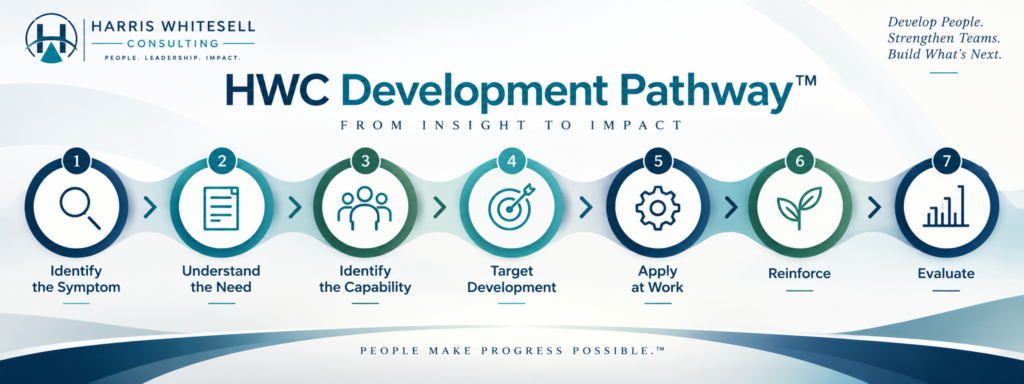
Figure 1: HWC Development Pathway™. Harris Whitesell Consulting. © 2026 Harris Whitesell Consulting. All rights reserved.
A workshop can be useful. An assessment can be useful. Coaching can be useful. But none of them should exist simply because they are available.
Development creates greater value when it addresses something the individual, team, or organization actually needs to become capable of doing.
Case Study: From Individual Expertise to Organizational Alignment
A financial-services firm we worked with illustrates this well.
Presenting concern: Leadership and team-development needs initially appeared to be separate problems.
What discovery revealed: The conditions were connected through unclear organizational philosophy, uneven leadership practices, career uncertainty, and weak talent-to-strategy alignment.
HWC’s response: We integrated leadership, team, career, and organizational development rather than prescribing a stand-alone workshop.
Observed change: Client-reported results included stronger strategic alignment, more constructive collaboration, improved engagement, and greater collective capacity to execute. The lesson from that work was not that every small business needs a large organizational-development initiative.
It was something more fundamental:
- People challenges rarely exist in isolation.
- A struggling manager affects a team.
- A team affects execution.
- Execution affects customers.
- Unclear career opportunities affect engagement and retention.
- Misaligned talent affects strategy.
- Leadership behavior affects culture.
- And the owner’s ability—or inability—to distribute responsibility affects the capacity of the entire organization.
That is why development has to connect the person, the leader, the team, and the business.
Note: This case is presented without identifying information to preserve client confidentiality. The outcomes described reflect the client’s engagement with HWC; they should not be interpreted as guaranteed outcomes for other organizations.
Why Capability Development Matters in a Small Business
The experience of one organization is instructive, but research across small and medium-sized businesses provides broader evidence for the relationship between people and management practices and organizational performance.
A 2025 meta-analysis of 115 SME studies found that high-performance work practices were positively associated with firm performance, growth, and innovation and negatively associated with turnover and absenteeism. At the employee level, these practices were also positively associated with engagement, motivation, creativity, job satisfaction, and organizational commitment (Hansen et al., 2025). The findings also reinforce the value of integrated systems of people practices rather than relying solely on isolated interventions.
Management practices matter as well. Research examining British SMEs found that smaller firms were less likely than larger organizations to use formal management practices; however, stronger management practices among SMEs were positively associated with firm survival, growth, and productivity (Forth & Bryson, 2019).
Although these studies do not evaluate the HWC Development Pathway™ specifically, they reinforce a broader conclusion: SMEs can benefit when management and people practices operate as an integrated system rather than as disconnected activities.
For the small-business owner, the implication is significant: developing people, leaders, teams, and the practices through which they work together should not be viewed simply as an employee benefit or training expense. It is an investment in the capability of the business itself – its capacity to lead, adapt, coordinate, execute, and grow.
What Development Can Enable in a Small Business
The value of development is not simply that employees “learn something.”
Its greater value lies in what stronger capability can enable.
For a small business, stronger capability may mean leaders who can make sound decisions without constantly escalating them to the owner; managers who can address performance rather than avoid it; and employees who can communicate effectively across different working styles.
It may also mean teams that can disagree without becoming dysfunctional, clearer responsibilities and stronger accountability, greater internal leadership capacity, better alignment between talent and strategy, stronger conditions for engagement and retention, and an organization better prepared for growth, transition, or change.
Development can also create leverage.
Every responsibility that can appropriately move from the owner to a capable leader creates additional capacity. Every manager who becomes more effective at developing others expands capability beyond one person. Every team that learns to solve problems constructively reduces unnecessary organizational friction. And every employee whose strengths and aspirations are better aligned with the needs of the business represents talent that can potentially be utilized more effectively.
This is why we encourage small-business owners to think differently about development.
Do not ask only, “What training should we offer?”
Ask: What does our business need our people to become more capable of doing?
That question changes the conversation.
HWC Small Business Leadership & Team Development
Small businesses deserve access to professional leadership and organizational development without having to purchase an enterprise-scale engagement.
The scope of development should reflect the need – not the size of a traditional consulting engagement.
That is the purpose behind HWC Small Business Leadership & Team Development.
Develop Your Leaders. Strengthen Your Team. Build Your Business.
Harris Whitesell Consulting works with small-business owners to identify what they are experiencing, better understand the capabilities that may be contributing to those conditions, and determine an appropriate development pathway. Depending on the need, that may include individual and team assessments, assessment debriefs, leadership development, team development, career development, coaching, facilitated workshops, or targeted organizational-development support.
The starting point is not the product.
It is the business need.
We might begin with a newly promoted manager who needs greater self-awareness and leadership capability. Another business may need a team assessment and facilitated workshop to address communication and collaboration. Another may need help strengthening its leadership pipeline. And another may discover that what first appeared to be a “people problem” is actually an issue of roles, structure, leadership, communication, or organizational alignment.
HWC provides practical, targeted solutions designed around your business, your people, and the capabilities they need to succeed.
Because small businesses cannot control every economic, technological, workforce, or competitive pressure they encounter.
But they can strengthen their capability to respond.
And sometimes the first step is simply recognizing the symptoms.
EXPLORE HWC SMALL BUSINESS LEADERSHIP AND TEAM DEVELOPMENT SOLUTIONS
Harris Whitesell Consulting helps businesses strengthen the human, leadership, team, and organizational capabilities that influence performance and enterprise impact. Through assessment, advisory, leadership and team development, coaching, facilitation, and organizational development, HWC helps leaders move from insight to action and from individual capability to collective performance.
Learn more: website | info@harriswhitesellconsulting.com | +1 (910) 409-0202 | LinkedIn.
About the Author
Lori Harris is Co-Founder and Principal Consultant of Harris Whitesell Consulting. Her work focuses on talent management, organizational effectiveness, leadership and team development, culture, and human and organizational capability. She is an executive, leadership, team, and career coach, facilitator, speaker, author, and host of the Maximize Excellence! Podcast. Contact: (910) 409-0202 | lori.harris@harriswhitesellconsulting.com
References
Federal Reserve Banks. (2026). 2026 report on employer firms: Findings from the 2025 Small Business Credit Survey. Small Business Credit Survey. https://doi.org/10.55350/sbcs-20260303
Forth, J., & Bryson, A. (2019). Management practices and SME performance. Scottish Journal of Political Economy, 66(4), 527–558. https://doi.org/10.1111/sjpe.12209
Hansen, C., Usanova, K., & Geraudel, M. (2025). A meta-analysis on the effects of high-performance work practices in small and medium-sized enterprises: An exploration of organizational- and individual-level outcomes. Journal of Business Venturing Insights, 24, e00572. https://doi.org/10.1016/j.jbvi.2025.e00572
Hruby, J., & Canfield, C. (2026). Beyond better programs: Building the organizational architecture that supports leadership learning transfer. Organizational Dynamics, 55(3), 101259. https://doi.org/10.1016/j.orgdyn.2026.101259
Söderhjelm, T. M., Nordling, T., Sandahl, C., Larsson, G., & Palm, K. (2021). Transfer and maintenance of knowledge from leadership development. Journal of Workplace Learning, 33(4), 273–286. https://doi.org/10.1108/JWL-05-2020-0079
U.S. Chamber of Commerce. (2026a, July 15). Current challenges: Small Business Index Q2 2026. https://www.uschamber.com/small-business/small-business-index-q2-2026?utm_source=chatgpt.com
U.S. Chamber of Commerce. (2026b, July 15). Executive summary: Small Business Index Q2 2026. https://www.uschamber.com/small-business/small-business-index-q2-2026?utm_source=chatgpt.com