
Symbiotic Leadership: Building Mutually Empowering Team Relationships
Success has never been a solo act. The most resilient, adaptive, and high-performing leaders and teams operate not through command-and-control or transactional cooperation—but through symbiotic relationships. Borrowed from biology, the term “symbiosis” refers to a close and long-term interaction between two or more different species that benefit from each other. In leadership and team dynamics, symbiosis becomes a metaphor—and a model—for sustainable performance, innovation, and human flourishing.
“In every successful team, the relationship is the performance.” —Peter Hawkins, Leadership Team Coaching
Why Symbiotic Relationships Matter in Leadership and Teams
A symbiotic relationship between leaders and team members fosters mutual benefit, shared accountability, and co-evolution. It’s a shift from the old hierarchy of “leader knows best” to a dynamic system where everyone contributes, adapts, and grows together. Neuroscience, organizational psychology, and behavioral assessments confirm that high-functioning teams thrive on connection, not control.
Research Highlights:
- Constructive organizational cultures, marked by achievement, humanistic-encouraging, and affiliative behaviors, outperform defensive cultures in engagement, innovation, and business outcomes (Human Synergistics, 2021).
- Psychological safety, the belief that one can take risks without punishment, is the #1 predictor of high-performing teams (Edmondson, 2019).
- Teams that operate with relational intelligence—understanding, valuing, and aligning with others’ communication styles—exhibit stronger cohesion and lower burnout (Goleman, 2006; Forte Institute, 2022).
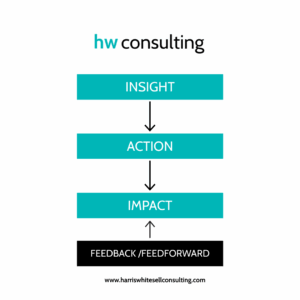
Symbiotic leaders and teams don’t happen by accident. They are built intentionally through valid people data and business aligned talent development strategies. At Harris Whitesell Consulting we work to align insights using valid assessment tools, action-high level behaviors that build symbiotic relationships, and impact-the measurable team data that reflects the health and performance of symbiotic teams that drives business results; and support the process with feedback and feedforward to refine development priorities, adapt relationship strategies, and sustain a continuous cycle of learning and growth.
Symbiotic leaders and teams are not just functional. They are formative: they grow capacity, unleash discretionary effort, and regenerate trust through every challenge.
Leadership Checklist: Building Symbiotic Team Relationships
In high-performing organizations, leadership is no longer just about setting direction—it’s about cultivating the quality of relationships that sustain performance over time. Symbiotic leadership goes beyond collaboration; it aligns and is driven by company vision and values and co-creates an intentional environment where both leaders and team members contribute to and benefit from one another’s success. These relationships are rooted in mutual trust, aligned values, adaptive communication, and shared responsibility—the very elements that fuel psychological safety, innovation, and resilience in times of change. But symbiosis doesn’t happen by accident. It must be designed, nurtured, and practiced.
The following eight leadership practices serve as a strategic checklist for building symbiotic team relationships. Each is grounded in research and is proven to enhance engagement, team intelligence, and leadership effectiveness. Leaders who consistently apply these practices don’t just manage teams—they activate ecosystems of growth, agility, and enduring value.
| Practice | Description |
| Assess Mutual Needs and Contributions | Regularly evaluate how each team member benefits and contributes. Tools like LSI™ or DiSC™ help uncover imbalances. |
| Build Trust Through Transparency | Create a culture of psychological safety where feedback is expected, not feared. |
| Clarify Shared Purpose | Co-create team purpose beyond KPIs. Symbiotic teams align around values, mission, and vision. |
| Align and Adapt Communication Styles | Use tools like Forté™ to understand and flex to others’ preferences. |
| Embrace Role Fluidity | Encourage cross-functional collaboration, skill-sharing, and mutual learning. |
| Normalize Reflection and Renewal | Schedule time to debrief, adapt, and recalibrate relationships—especially after conflict or change. |
| Develop Relational Intelligence | Train leaders to read social cues, navigate tension, and support diverse contributions. |
| Balance Results with Relationships | Make decisions that optimize both task and people dynamics. Symbiosis thrives when performance and wellbeing are integrated. |
Leadership in Action: From Transactional to Symbiotic
Symbiotic leadership is not about being soft—it’s about being strategically human. In high-stakes environments, symbiotic teams outperform because they trust faster, adapt smoother, and grow stronger together.
A mid-sized engineering firm with 350 employees had a reputation for innovation but suffered from internal silos, leadership turnover, and stagnant team engagement. A newly appointed executive inherited a department known for brilliant minds and broken trust. Teams worked in parallel, not partnership. Communication breakdowns slowed launches. Psychological safety was low, and feedback often went unspoken.
Recognizing the need for a culture shift, this executive partnered with Harris Whitesell Consulting to lead a 12-month culture transformation initiative grounded in symbiotic team principles. The goal was not just to increase performance, but to rebuild trust, communication, and mutual responsibility across project teams and leadership levels.
With leadership vision and team commitment they shifted to a more constructive culture where achievement, collaboration, productive conflict, discretionary efforts, co-creation, engagement, performance, and well-being thrived!
This evolution shows that symbiotic relationships are not abstract ideals – they are strategic assets. With the right assessment tools, intentional leadership practices, and relational intelligence, even the most high-stress, technical environments can become ecosystems of trust, learning, and shared success.
“The best leaders are note heroes. They are hosts-social architects who convene, connect, and catalyze others toward a shared purpose.” —Margaret Wheatley, Leadership and the New Science
When leaders apply psychometric and leadership assessments, organizational culture and development, change management and leadership models, team dynamics, and communication tools within a symbiotic mindset, they transform their teams into intelligent, interdependent systems—resilient in the face of disruption, aligned in vision, and energized by mutual value.
Harris Whitesell Consulting, LLC., is a human capital and talent management consulting firm headquartered in Wilmington, North Carolina. Our mission is to create valued partnerships based on trust, excellence, and impact – from assessment to action. We offer assessment, coaching, development, culture, and engagement, change and transition, talent optimization, and customer strategy solutions. Our team of certified and highly qualified experts maximize organizational and leadership effectiveness and business success by working with people and businesses to accelerate value, optimize growth and opportunities for their leaders, teams, and organizational success! We maximize excellence!
Learn more about our services: visit our website, email us at info@harriswhitesellconsulting.com, call us at +1 (910) 409-0202, and…connect, follow, and reach out to us on LinkedIn.
About the Author
Lori Harris is Co-Founder/Co-Owner and Managing Partner of Harris Whitesell Consulting. She is an experienced Talent Management Executive providing world-class service in Organizational & Culture Effectiveness| Talent Optimization| Organizational, Executive, Leadership & Team Development & Coaching | People Data Expert | Author, Speaker, and Thought Leader.
Contact: (91) 409-0202 | lori.harris@harriswhitesellconsulting.com
Sources
- Edmondson, A. C. (2019). The fearless organization: Creating psychological safety in the workplace for learning, innovation, and growth. John Wiley & Sons.
- Forte Institute. (2022). The Forté Communication Style Profile. https://www.theforteinstitute.com
- Goleman, D. (2006). Social intelligence: The new science of human relationships. Bantam.
- Human Synergistics International. (2021). Constructive cultures and organizational effectiveness. https://www.humansynergistics.com
- Lencioni, P. (2002). The five dysfunctions of a team: A leadership fable. Jossey-Bass.
- Rock, D. (2009). Your brain at work: Strategies for overcoming distraction, regaining focus, and working smarter all day long. HarperBusiness.