Slow Down to Speed Up: Why Leaders Default to Action Instead of Clarity – A practical perspective on executive leadership decision making and improving team performance.
Most leaders don’t struggle with action. They struggle with slowing down long enough to get it right. And in most organizations, that distinction gets missed. In executive leadership, the pressure for speed often overrides disciplined decision making. The results is misalignment, rework, and reduced team effectiveness.
Speed is what gets rewarded. Faster decisions. Faster execution. Faster results. Leaders are praised for urgency, responsiveness, and action. Calendars fill. Meetings stack. Activity becomes the visible signal of value.
And yet, many of the fastest-moving teams are not the ones producing the best outcomes. They’re simply moving faster in the wrong direction.
The Hidden Cost of Reactive Leadership and Constant Motion
At the leadership level, the pressure to move quickly is real. Markets shift. Customers expect immediacy. Internal stakeholders want answers now.
When speed outruns clarity, a few things happen:
- Decisions made on incomplete or misinterpreted information
- Teams executing before alignment is established
- Rework, reversals, and “start-stop” momentum
- Leaders solving symptoms instead of root issues
Google’s Project Aristotle found the same thing. Teams that perform at the highest level are not the busiest. They’re the clearest on structure, roles, and expectations.
From the outside, the team looks productive. From the inside, it feels chaotic.
What’s missing is not effort. It’s discipline. The discipline to pause long enough to understand what’s actually happening before taking action.
Slowing Down Is Not Hesitation. It’s Precision.
Strong leaders don’t slow down because they’re unsure. They slow down because they’re intentional. They understand that a short, well-placed pause at the right moment can eliminate weeks of wasted effort later.
Kahneman captured this distinction in Thinking, Fast and Slow. Fast thinking drives quick reactions. Slow thinking enables better decisions. Leadership requires both, but many organizations reward speed above all else.
Slowing down, here, means:
- Taking the time to diagnose what is actually happening, not just what is visible
- Clarifying the real objective, not the assumed one
- Aligning on roles, expectations, and ownership before execution begins
- Considering second-order impacts, not just immediate outcomes
This isn’t about over-analysis. It’s about getting it right the first time.
Where Leaders Need to Slow Down Most
There are a few predictable moments where slowing down delivers the highest return.
- At the Start of Anything New
New initiatives, new teams, new strategies. This is where leaders are most tempted to “get moving.” It’s also where misalignment is most expensive. A 30-minute alignment conversation at the beginning can prevent 30 days of rework, missed expectations, and quiet frustration across a team. - When Things Feel Off
Missed deadlines. Tension on the team. Work that keeps getting redone. The instinct is to push harder. The better move is to pause and ask: what is actually causing this? Leaders who slow down here stop reacting and start resolving. - Under Pressure
When timelines compress, most leaders default to speed. But pressure is exactly when clarity matters most. Harvard Business Review has noted that urgency often narrows thinking and drives leaders toward habitual, less effective responses unless they create space to think.
The Leadership Capability That Drives Better Decisions and Results
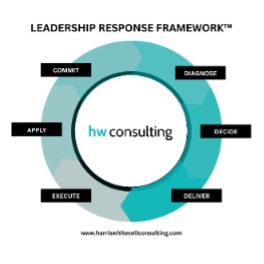
Slowing down to speed up isn’t a tactic. It’s a capability. It requires leaders to build the habit of working through a disciplined response. Harris Whitesell Consulting’s Leadership Response Framework™ reinforces this discipline through six steps:
The first four steps guide the response in real time.
The final two ensure it is applied and sustained.
- Diagnose what is really happening beneath the surface
- Decide what the situation actually requires
- Deliver the response so it lands with the people involved
- Execute with clarity and follow-through
- Apply what the situation is teaching you, not just what you already know
- Commit to the action with full follow-through, not just intent
Many leaders skip these steps entirely. They see a problem and move directly to action. That’s where speed becomes costly.
Both Boston Consulting Group and Bain & Company confirm that decision quality, not decision speed alone, is what differentiates high-performing organizations.
Why Leaders Resist It
Even when leaders understand the value, slowing down is often uncomfortable. It can feel like:
- Losing momentum
- Holding up progress
- Not having immediate answers
- Creating space where others expect direction
This pause doesn’t create doubt. It builds confidence. Teams trust leaders who create clarity. They disengage from leaders who create motion without direction.
What It Looks Like in Practice
This doesn’t show up in big moments. It shows up in small, visible leadership behaviors:
- Asking two more questions before giving direction
- Clarifying “what success looks like” before assigning work
- Naming trade-offs explicitly instead of assuming alignment
- Pausing a meeting to realign on purpose when the conversation drifts
- Stopping execution briefly when something doesn’t make sense
Simple moves. But they require intention.
The Payoff
When leaders slow down at the right moments, a few things change:
- Faster execution once work begins
- Fewer course corrections
- Higher-quality decisions
- Stronger alignment across teams
- Increased trust and ownership
They actually move faster. Just not in the way most organizations define speed.
A Final Thought
Speed is not about how quickly you start. It’s about how effectively you finish. The leaders who create real momentum aren’t the ones who rush into action. They’re the ones who take the time to ensure the action is right.
Before you push for more speed this week, pause and ask: Are we moving fast, or just moving without clarity?
About Harris Whitesell Consulting
Harris Whitesell Consulting partners with organizations to design and implement leadership development systems that are practical, science-based, and results-driven. From leadership transition strategy to executive coaching and talent architecture, the focus is on building leadership capability that scales—aligning people, performance, and culture.
Learn more: website | info@harriswhitesellconsulting.com | +1 (910) 409-0202 | LinkedIn.
About the Author
Lynn Whitesell is Partner and Principal at Harris Whitesell Consulting specializing in executive leadership, organizational effectiveness and leadership development. A Human Capital Strategist and Organizational Effectiveness Advisor with 30 years of global leadership experience, Lynn helps executives and organizations navigate transformation, strengthen leadership capability, and align culture with strategy. Her work spans executive coaching, leadership development, organizational transformation, and talent optimization, with deep experience supporting organizations through periods of change, integration, and cultural alignment. Contact Lynn: +1 (910) 398-2953 | lynn.whitesell@harriswhitesellconsulting.com
References
Google. (2016). Guide: Understand team effectiveness (Project Aristotle). Google re:Work. https://rework.withgoogle.com/guides/understanding-team-effectiveness/steps/introduction/
Daniel Kahneman. (2011). Thinking, fast and slow. Farrar, Straus and Giroux.
Harvard Business Review. (2020). Don’t let urgency override good judgment. https://hbr.org/2020/09/dont-let-urgency-override-good-judgment
Boston Consulting Group. (2019). The power of good decisions. https://www.bcg.com/publications
Bain & Company. (2019). Great decisions: Why they matter and how to make better ones. https://www.bain.com/insights