The Conversation You’re Avoiding Is Probably the One That Matters Most
A practical framework for direct conversations that build clarity, responsibility, and accountability.
During a recent leadership workshop, I asked participants to name a conversation they knew they needed to have. Not someday. Not eventually. A real one, sitting on their desk right now. Pens started moving within seconds.
One leader needed to address a performance concern. Another had a team member who kept missing commitments. Someone described a peer relationship that had grown strained because the two of them had never directly discussed expectations. A few people pointed to decisions that had been sitting untouched for weeks because nobody wanted to claim ownership for the next step.
What struck me wasn’t how fast people identified the conversation. It was how clearly they already understood the problem. They knew what needed to be said. The hard part wasn’t awareness. It was action.
That same pattern shows up again and again. Most leadership problems don’t start with a lack of talent or effort. They start when a conversation that needs to happen gets put off instead.
A performance issue goes unaddressed. Expectations stay vague. Nobody is quite sure who owns what. A decision sits in limbo. A conflict simmers under the surface of a few too many meetings. And a small, manageable issue grows into something much bigger, usually because nobody was willing to name it out loud.
Many leaders think of these as difficult conversations. We see them differently. At Harris Whitesell Consulting, we call them direct conversations because the goal isn’t to make conversations harder. The goal is to create clarity, strengthen relationships, and improve performance through honest, respectful communication.
We Usually Know What Needs to Be Said
Ask leaders why they’re avoiding a difficult conversation at work and the answers tend to sound the same. They don’t want to damage the relationship. They’re worried about creating conflict. They think the other person will get defensive. They want more information first, or they’re still looking for exactly the right words, which is often just another way of buying time.
Most of these instincts are well-intentioned. Leaders want to be respectful. They care about their people and don’t want to wreck the trust they’ve built. As Patrick Lencioni has written, teams that build trust are willing to engage in productive conflict rather than avoiding the conversations that matter most.
Avoiding the conversation rarely protects any of that. In reality, avoiding a difficult conversation often creates a much bigger leadership challenge than addressing it early. Research on psychological safety suggests that trust isn’t built by avoiding difficult conversations but by addressing them with honesty, respect, and mutual responsibility.
Most of the damage leaders end up dealing with isn’t caused by the hard conversation itself. It’s caused by the delay. The longer something goes unaddressed, the more room there is for people to fill the silence with their own assumptions. The employee assumes they’re meeting expectations. The leader assumes the employee understands the impact of what they’re doing. A colleague assumes someone is already handling it. Everyone is operating off a slightly different version of the same situation, and it feels like alignment until it isn’t.
Eventually those assumptions run into reality. Deadlines slip. Frustration builds. Trust starts to wear thin, and leaders find themselves having the same conversation repeatedly, wondering why nothing’s changed. Usually the answer is simple. The conversation that would have created clarity never actually happened.
The Cost of Avoiding Responsibility and Accountability
Research from CPP, Inc. (now The Myers-Briggs Company) found that U.S. employees spend close to three hours a week dealing with unresolved conflict at work, a cost that runs into the hundreds of billions of dollars annually in lost productivity. The cost of avoiding these conversations extends well past any single relationship. It shows up in execution, in responsibility and accountability, in how decisions get made, and ultimately in the culture of the entire organization. Whether the issue involves employee performance, missed commitments, workplace conflict, or unclear expectations, direct conversations create the clarity organizations need to execute well.
Plenty of organizations spend their energy treating symptoms instead of the actual root cause. Teams struggle to follow through when nobody’s sure who owns what. Leaders end up carrying work that should belong to someone else. Employees get frustrated because expectations seem to shift without anyone saying so. Projects stall because a decision got made in someone’s head but never out loud.
A performance issue is often a clarity issue wearing a different name. A lack of ownership is usually a breakdown in expectations. And what looks like a people problem is, more often than not, a conversation that never happened. Gallup has long identified “I know what is expected of me at work” as one of the foundational elements of employee engagement. That finding reinforces a simple truth: when expectations are clear, people are far more likely to perform, take ownership, and succeed.
We see this pattern hold up no matter the size of the organization or the industry it’s in. When expectations are clear, ownership is defined, and leaders deal with issues early, execution gets better. When ambiguity is allowed to sit, performance suffers. Every time.
That’s part of why communication matters so much in leadership.
We tend to talk about leadership in terms of strategy, vision, and decision-making. Those things matter. But a lot of leadership actually happens in ordinary conversations. The one that sets priorities straight. The one that names who’s responsible for what. The one that gives honest feedback. The one that catches a circumstance before it turns into a crisis. That’s where leadership shows up, whether anyone’s watching or not.
Direct and Respectful
One of the most common misconceptions we run into is the idea that being direct requires a harder edge.
A lot of leaders hear “direct” and think “confrontational.” They worry that speaking plainly will come across as aggressive or unkind, so they soften the message, dance around the real issue, or wrap so much cushioning around the feedback that the actual point gets lost somewhere inside it.
The best leaders do something different. They’re direct because they’re clear, not because they’re trying to win a point or prove a position. They name the issue without attacking the person. They set expectations without creating fear. They give honest feedback while still treating people with respect.
Clarity, it turns out, is one of the more respectful things a leader can offer. People want to know where they stand. They want to understand what success actually looks like, and they’d usually rather hear something honest than sit in uncertainty wondering what’s really going on. Being direct doesn’t mean being harsh. Direct conversations are not about confrontation. They’re about giving people the clarity they need to succeed. It means being clear about the situation, the impact, the expectation, and what happens next. When leaders show up with that kind of clarity, people tend to rise to meet it.
A Framework for Conversations That Matter
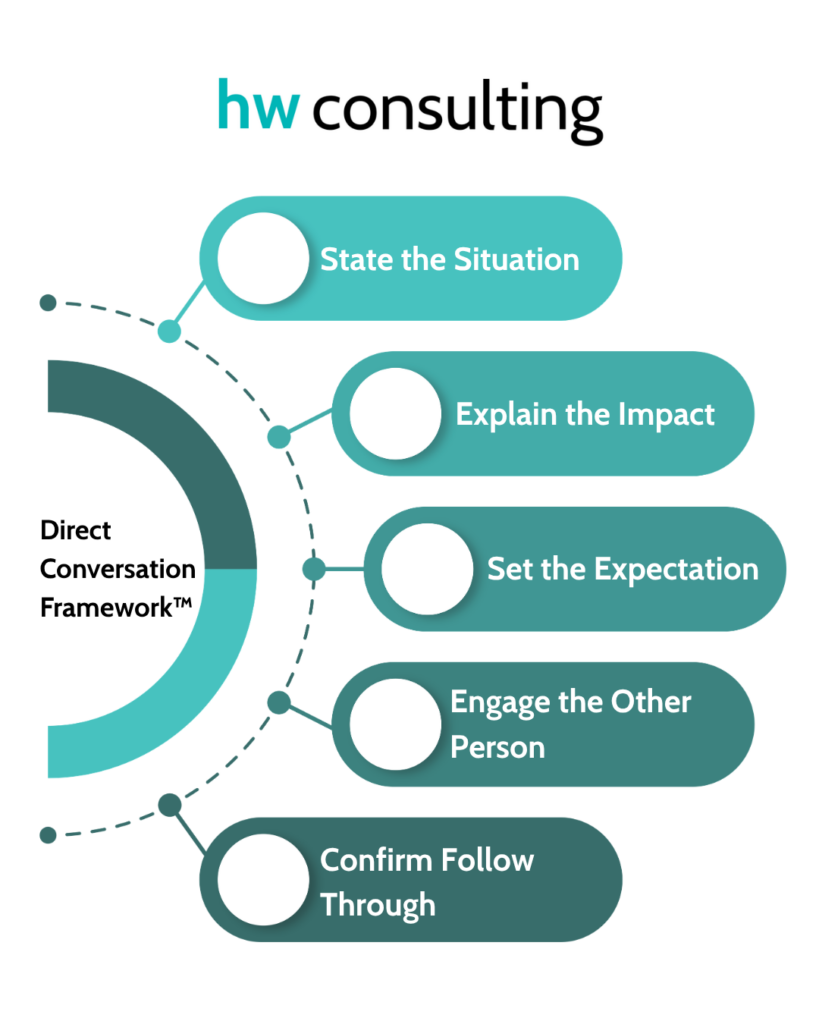
After years of coaching leaders and facilitating leadership development across industries, we recognized the same pattern time and again. That’s why we developed the HWC Direct Conversation Framework™ to help leaders navigate important conversations with confidence, clarity, and respect.
State the Situation. The framework begins here, describing what’s happening in specific, factual terms rather than vague impressions, so both people are working from the same set of facts.
Explain the Impact. This is the step leaders skip most often. Why does this matter? How is it affecting the work, the team, or the ability to follow through? Skipping it is usually what makes a conversation feel like criticism instead of context.
Set the Expectation. Once the impact is clear, the conversation turns to naming what needs to happen from here, and establishing what clear ownership and follow-through look like going forward.
Engage the Other Person. The framework isn’t meant to be a monologue, which is why this step means inviting their perspective, their read on the situation, and their part in solving it. A conversation that only flows in one direction rarely produces genuine ownership.
Confirm Follow Through. The framework closes here, getting specific about commitments, next steps, timing, and who’s doing what, so the conversation actually leads somewhere instead of trailing off into good intentions.
None of this is meant to make conversations feel scripted or stiff. The point is to give leaders enough structure that they can walk into an important conversation with confidence instead of dread and walk out of it with clarity instead of just relief that it’s over.
At its core, the framework rests on the simple belief that most leadership problems get better when people are willing to talk about them directly, respectfully, and early.
We spend a lot of time as leaders focused on goals, priorities, and outcomes. But most of those outcomes are downstream of conversations. The conversation creates clarity. Clarity creates alignment. Alignment strengthens ownership. Ownership is what allows teams to execute consistently.
So, the next time you catch yourself putting off a conversation you know you need to have, it’s worth asking one simple question. What is the cost of waiting?
The conversation you’re avoiding might be uncomfortable. It might take more courage than you’d like, and it might not go exactly as planned. There’s also the real possibility it’s the conversation that matters most.
About HWC
Harris Whitesell Consulting, LLC is a global human capital and talent management consulting firm. We partner with organizations to strengthen leadership, elevate culture, and align people systems with business strategy. Our work spans leadership development, executive coaching, organizational effectiveness, culture and engagement, change and transition, talent optimization, and customer strategy. Our approach is simple: evidence-based insights, practical solutions, measurable impact. From assessment to action, we help organizations build capability and grow with intention.
Learn more: website | info@harriswhitesellconsulting.com | +1 (910) 409-0202 | LinkedIn.
About the Author
Lynn Whitesell is Partner and Principal at Harris Whitesell Consulting, specializing in executive leadership, organizational effectiveness, and leadership development. A Human Capital Strategist and Organizational Effectiveness Advisor with 30 years of global leadership experience, Lynn helps executives and organizations navigate transformation, strengthen leadership capability, and align culture with strategy.
Her work spans executive coaching, leadership development, organizational transformation, and talent optimization, with deep experience supporting organizations through change, integration, and cultural alignment.
Contact: (910) 398-2953 | lynn.whitesell@harriswhitesellconsulting.com
References
CPP, Inc. (now The Myers-Briggs Company). (2008). Workplace Conflict and How Businesses Can Harness It to Thrive. https://www.themyersbriggs.com/Pdfs/CPP_Global_Human_Capital_Report_Workplace_Conflict.pdf
Edmondson, A. C. (2019). The Fearless Organization: Creating Psychological Safety in the Workplace for Learning, Innovation, and Growth. John Wiley & Sons.
Gallup. (n.d.). Q01: I know what is expected of me at work. Gallup Q12 Employee Engagement Survey. https://www.gallup.com/workplace/356045/q12-question-summary.aspx
Knight, R. (2015). How to Handle Difficult Conversations at Work. Harvard Business Review. https://hbr.org/2015/01/how-to-handle-difficult-conversations-at-work
Lencioni, P. (2002). The Five Dysfunctions of a Team: A Leadership Fable. Jossey-Bass.