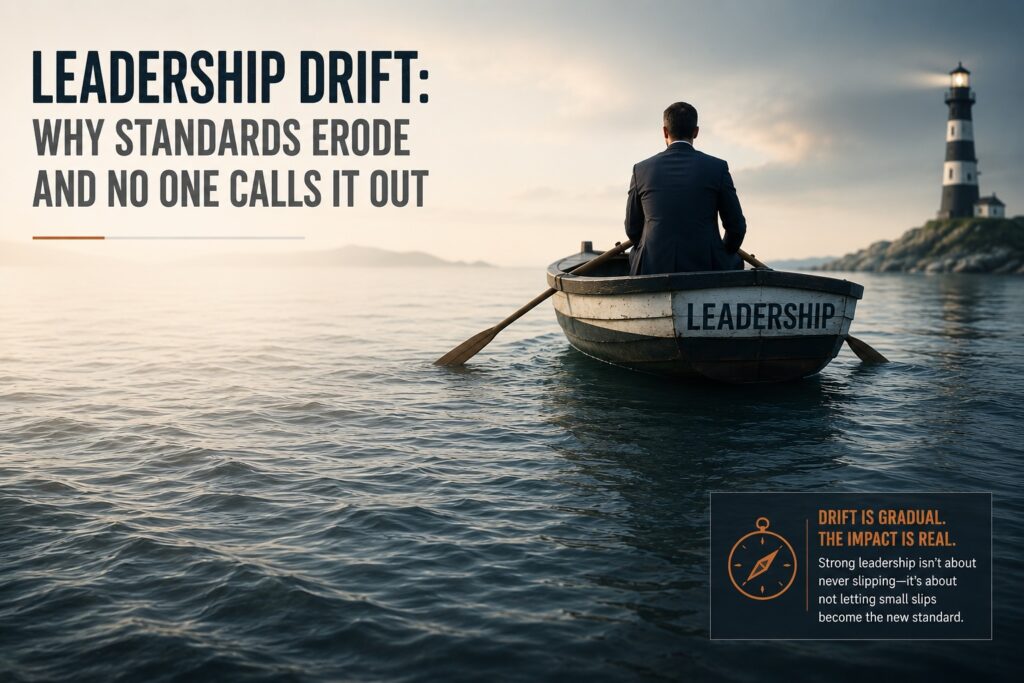
Leadership Drift: Why Standards Erode and No One Calls It Out
How small lapses in responsibility and accountability quietly erode leadership effectiveness, team alignment, and organizational culture
Most leaders never decide to lower their standards.
In our work with leadership teams, drift rarely begins with a major failure, a dramatic conflict, or a visible breakdown. More often, it starts with a series of small moments that seem insignificant at the time, none of them serious enough to address on their own. A commitment slips and nobody follows up. A behavior that doesn’t align with stated values gets a pass because the timing feels wrong. A decision remains unresolved long enough that people start working around it instead of waiting for clarity.
Those moments begin to change expectations all the same. Over time, people stop operating according to the standards leaders believe are in place and start operating according to the standards that are actually being reinforced every day.
That is leadership drift, small lapses that compound over time. The shift is gradual enough that most organizations don’t recognize it until the effects begin showing up in performance, ownership, decision-making, or culture.
What Weak Responsibility and Accountability in Leadership Really Looks Like
Drift rarely appears as a single bad decision. More often, it shows up as inconsistency that nobody names.
One leader holds a firm line on commitments while another routinely extends deadlines. One manager addresses performance concerns directly while another avoids difficult conversations. One team operates with clear expectations while another relies on assumptions.
Individually, these differences may not seem significant. Over time, however, they create very different employee experiences inside the same organization.
A leadership team may believe it is operating from a shared set of standards, while employees experience something very different. What gets enforced begins to depend on who a person reports to rather than on a consistent organizational expectation. What starts as flexibility gradually becomes inconsistency.
I’ve seen organizations where employees can predict the culture of a department simply by knowing who leads it. That’s rarely a sign of healthy alignment.
McKinsey’s research on organizational health identifies strategic clarity, role clarity, and personal ownership as power practices, behaviors with an outsized effect on performance whose absence creates a significant drag on results. Organizations strongly aligned around these practices are six times more likely to land in the top quartile of organizational health than those with weak alignment. When those practices begin to erode, the decline rarely happens overnight. People gradually adjust to a lower standard and eventually stop noticing the shift.
Most leadership teams see drift long before they address it. The challenge is rarely awareness. More often, it’s discomfort.
Addressing drift usually requires a difficult conversation. It may mean challenging a peer, revisiting a decision that everyone assumed was settled, or confronting a behavior that has been tolerated for too long. In fast-moving organizations, leaders often convince themselves there are more urgent priorities, but the problem is that drift compounds.
The conversation that feels uncomfortable today is almost always easier than the conversation required six months from now.
Another reason leaders stay silent shows up in Amy Edmondson’s research on psychological safety. When people are uncertain how concerns will be received, they often choose not to raise them. On leadership teams, that silence can easily be mistaken for agreement when it is actually caution, and teams rarely fail because of strategy alone. More often, they struggle because conflict is avoided and ownership becomes unclear, and leadership drift thrives in exactly those conditions.
The Cost Shows Up Later
One of the reasons drift is so difficult to recognize is that the consequences don’t show up immediately. At first, everything appears fine. Then decisions start taking longer than they should. Priorities become less clear. People begin interpreting expectations differently. Trust starts to weaken around the edges.
Eventually, leaders find themselves asking why execution feels harder than it used to.
The answer is often not capability. It is clarity. People perform best when expectations are clear and consistently reinforced. When standards become negotiable, employees spend more time interpreting what matters and less time executing against it.
A common example is a leadership team that agrees on a priority but never addresses missed commitments related to that priority. Each delay has a reasonable explanation. Each exception seems justified. Eventually the issue is no longer the missed deadline. The issue is that the organization has quietly learned that deadlines are optional.
The financial and operational costs of drift are significant precisely because they accumulate slowly. By the time leaders recognize the impact, the behaviors have often become habits and the habits have become culture.
Organizations invest considerable time defining values, competencies, and leadership expectations, and those things matter. But culture is shaped far more by what leaders consistently reinforce than by what appears on a poster, slide deck, or website.
People watch what leaders do far more closely than what they say. Gallup’s ongoing research on workplace performance has found that managers account for the majority of the variance in employee engagement, which is a strong signal that culture follows what gets allowed, not what gets said. In our experience, organizations rarely drift because expectations weren’t communicated. They drift because expectations weren’t consistently reinforced.
Over the years, one pattern has remained remarkably consistent. High-performing cultures are not necessarily built by extraordinary leaders. They are built by leaders who consistently reinforce expectations, address issues early, and follow through on what they say they value.
The opposite is also true. Leaders do not have to actively damage culture to lose control of it. They simply have to stop maintaining it.
Leadership drift tends to become visible during periods of growth, change, or sustained pressure. New leaders join the organization. Teams expand. Priorities shift. Resources become stretched. Expectations that were once obvious are no longer shared by everyone involved. I’ve seen leadership drift emerge most often during these periods because leaders are understandably focused on speed and execution. Ironically, those are the times when clarity and consistency matter most.
Boston Consulting Group’s research on transformation has found that about 70 percent of transformations fall short of their goals, and that success hinges less on strategy than on leadership commitment and a sustained focus on culture. Harvard Business Review has made a similar observation, that when leaders feel rushed, they often default to habit rather than judgment.
These conditions are not unusual. They represent the normal operating environment for many organizations today. That is why leadership drift should not be viewed as an occasional challenge. It is an ongoing matter of leadership responsibility and accountability.
What Consistent Leaders Do Differently
Leaders who avoid drift are not necessarily tougher than everyone else. They are more consistent.
They address situations while they are still small. They clarify expectations before misunderstandings develop. They are willing to create a little short-term discomfort to avoid much larger problems later. Most importantly, they recognize that culture is built through repeated actions, not occasional interventions.
A difficult conversation held today builds culture over the long run. So does a commitment that gets clarified rather than quietly dropped, and so does reinforcing a standard even when it feels small in the moment. None of it is dramatic. It is simply consistent, and consistency is what keeps drift from taking hold.
A Quick Gut Check on Difficult Conversations
If you’re leading a team today, consider these questions:
- Where have your standards quietly shifted during the last year?
- What behavior have you noticed but not addressed?
- What are you tolerating today that you would not have accepted twelve months ago?
The answers are often the first sign that a deeper culture or leadership assessment is needed.
Standards Get Set Every Day, Not Just in Big Moments
Leadership effectiveness is rarely determined by a handful of highly visible moments. It is shaped by the hundreds of small decisions leaders make every day.
Reinforcing a standard strengthens culture, ignoring a behavior reshapes it, and avoiding a difficult conversation creates a new expectation whether you intended it or not. What we’ve seen across client engagements is that culture rarely changes because of a single decision. It changes through the standards leaders consistently reinforce or choose not to.
The question is not whether leadership drift exists somewhere in your organization. It almost certainly does.
The question is whether you are willing to address it before it becomes the new normal.
Harris Whitesell Consulting, LLC is a global human capital and talent management consulting firm. We partner with organizations to strengthen leadership, elevate culture, and align people systems with business strategy. Our work spans leadership development, executive coaching, organizational effectiveness, culture and engagement, change and transition, talent optimization, and customer strategy. Our approach is simple: evidence-based insights, practical solutions, measurable impact. From assessment to action, we help organizations build capability and grow with intention.
Learn more: website | info@harriswhitesellconsulting.com | +1 (910) 409-0202 | LinkedIn.
About the Author
Lynn Whitesell is Partner and Principal at Harris Whitesell Consulting, specializing in executive leadership, organizational effectiveness, and leadership development. A Human Capital Strategist and Organizational Effectiveness Advisor with 30 years of global leadership experience, Lynn helps executives and organizations navigate transformation, strengthen leadership capability, and align culture with strategy. Her work spans executive coaching, leadership development, organizational transformation, and talent optimization, with deep experience supporting organizations through change, integration, and cultural alignment.
Contact: (910) 398-2953 | lynn.whitesell@harriswhitesellconsulting.com
REFERENCE
Harvard Business Review. (2020). Don’t Let Urgency Override Good Judgment. https://hbr.org/2020/09/dont-let-urgency-override-good-judgment
Boston Consulting Group. (2023). Transformation Challenges in Uncertain Times. https://www.bcg.com/publications/2023/transformation-challenges-in-uncertain-times
McKinsey & Company. Organizational health is (still) the key to long-term performance. https://www.mckinsey.com/capabilities/people-and-organizational-performance/our-insights/organizational-health-is-still-the-key-to-long-term-performance
Gallup. (2024). World’s Largest Ongoing Study of the Employee Experience. https://www.gallup.com/workplace/649487/world-largest-ongoing-study-employee-experience.aspx
Edmondson, A. (1999). Psychological Safety and Learning Behavior in Work Teams. Administrative Science Quarterly, 44(2), 350–383. https://doi.org/10.2307/2666999
Google re:Work. (2016). Guide: Understand team effectiveness (Project Aristotle). https://rework.withgoogle.com/guides/understanding-team-effectiveness/steps/introduction/
Lencioni, P. (2002). The Five Dysfunctions of a Team. Jossey-Bass.