The Mirror No One Wants and Every Leader Needs
Why 360-Degree Feedback, done well, provides value, growth, and opportunity for leaders, teams, and organizations.
“What if the greatest risk to your leadership is not what you know… but what you cannot see?”
Michael R. had spent twenty-seven years building his reputation. As President of a manufacturing company with 1,200 employees, he was known for operational excellence, strategic discipline, and relentless accountability.
Results followed him. Promotions followed him. Success followed him. People respected him. Or so he thought.
The Success Problem Nobody Talks About
The board wasn’t concerned about performance. Revenue had grown. Margins had improved. Customers were satisfied. Yet something else was happening.
High-potential leaders were leaving. Cross-functional collaboration had deteriorated. Executive meetings had become increasingly quiet. Innovation had slowed. And despite his intelligence and experience, Michael could not understand why.
“I’ve given my life to this organization,” he said. “What am I missing?”
The board chairman offered an unexpected answer. “You may not need another strategy. You may need another mirror.”
The Objections Were Immediate
Michael hated the idea. Like many executives, he had heard the arguments:
“360s are popularity contests.”
“People weaponize anonymous feedback.”
“Everyone has biases.”
“Leaders don’t need more surveys.”
“I’ve been successful for decades. Why start now?”
The objections were reasonable. And in many cases, they are true.
Poorly designed 360-degree assessments can create distrust, anxiety, and defensive behavior. When administered without expertise, they often become exercises in data collection rather than leadership development.
The assessment itself isn’t the problem. The process is.
The Science Behind Seeing Ourselves
Research consistently demonstrates that self-awareness predicts leadership effectiveness.
A study by Center for Creative Leadership found that leaders whose self-ratings closely aligned with the perceptions of others were significantly more effective and more likely to succeed over time.
Meanwhile, research by Korn Ferry suggests that only 10–15% of people possess high levels of self-awareness despite most believing they do.
The problem isn’t intelligence. The problem is visibility.
Power changes information flow. The higher leaders rise, the less truth they naturally receive. People edit. People filter. People protect. Over time, leaders can become increasingly disconnected from the experience they create for others.
Not because they are bad leaders. Because they are human.
Why an External Consulting Firm Matters
Michael’s board wisely refused to turn the process into an HR exercise. Instead, they engaged an external consulting firm accredited in leadership assessments and executive coaching.
Why?
Because a 360-degree assessment is not merely measurement. It is interpretation.
Data without context creates confusion. Feedback without coaching creates defensiveness. Insight without development creates frustration.
Experienced consultants bring:
- Validated, research-based instruments
- Confidentiality and psychological safety
- Neutral interpretation
- Pattern recognition
- Executive coaching
- Development planning
- Accountability
- Longitudinal measurement
The goal isn’t judgment. The goal is understanding.
The Feedback That Changed Everything
Michael expected criticism. He expected complaints. Instead, a pattern emerged.
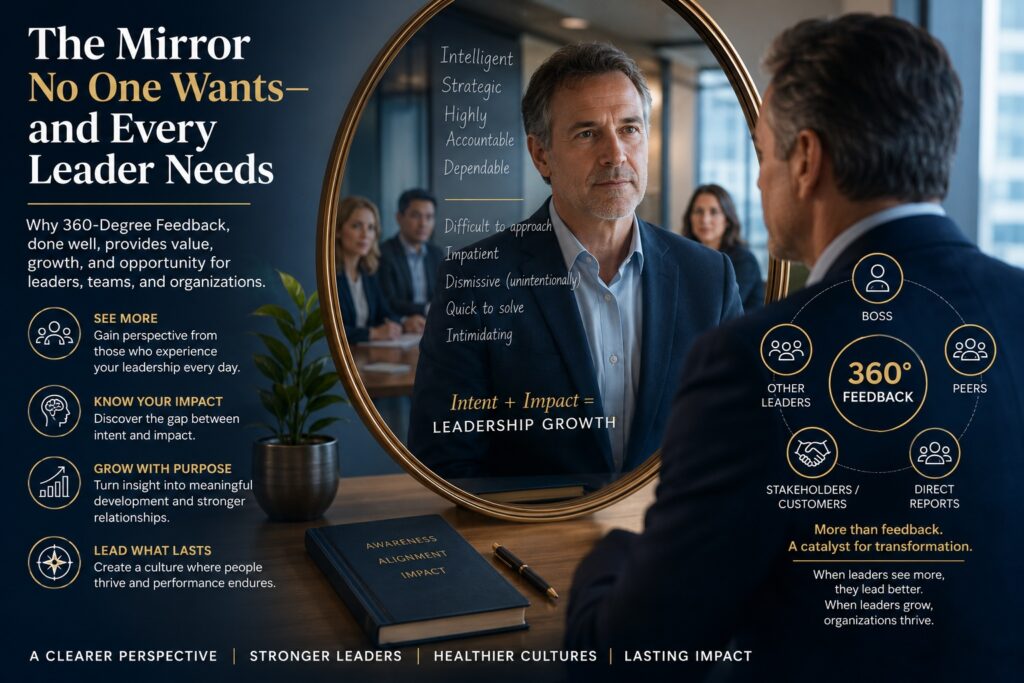
Across his selected raters – superiors, boss, peers, direct reports, and stakeholders – people consistently described him as:
- Intelligent
- Strategic
- Highly accountable
- Dependable
But another pattern appeared.
They also experienced him as:
- Difficult to approach
- Impatient during discussions
- Unintentionally dismissive
- Quick to solve rather than listen
- Intimidating without meaning to be
One comment stopped him. “He cares deeply about people. I know he does. I just don’t always experience it.”
He read that sentence repeatedly. Tears formed. Not because it was unfair. Because it was true.
Intent and impact had separated.
And for the first time in years, he could see himself from the other side.
Feedback Is About Wholeness, Not Weakness
Leadership development is not about fixing broken people. It is about integrating the whole person – their strengths, blind spots, motivations, stress patterns, behavioral tendencies, and communication habits.
Leadership effectiveness lies not in perfection, but in alignment. Wholeness occurs when intentions, behaviors, and impact become increasingly congruent.
This is why executive coaching matters. The purpose of feedback is not shame. It is awareness. And awareness is where growth begins.
Twelve Months Later
The transformation wasn’t dramatic. It was human.
Michael learned to pause. He asked more questions. He became curious before becoming corrective. He invited dissent. He listened longer. He coached more and solved less.
Within twelve months:
- Executive team trust scores increased 28%.
- Voluntary turnover among key talent decreased 19%.
- Employee engagement improved.
- Collaboration across functions strengthened.
- Succession candidates became more visible.
- Innovation discussions became more frequent.
The organization didn’t change because strategy changed. The organization changed because the leader changed.
Leadership is not simply what executives accomplish.
Leadership is what remains in the organization because they were there.
~ Harris Whitesell Consulting
Culture changes one relationship at a time. Relationships change when leaders become more aware of themselves. The organization did not change because strategy changed, the organization changed because the leader changed. And people experienced that change.
The Greatest Gift a Leader Can Receive
Most leaders spend years developing competencies. Far fewer develop perspective. Competencies create performance. Perspective creates legacy. A 360-degree assessment is not about exposing flaws. It is about revealing possibilities.
Done poorly, it becomes another survey.
Done well—with validated science, experienced consultants, and skilled executive coaching—it becomes something much more powerful.
A mirror.
And sometimes the greatest act of leadership is having the courage to look.
The Gift of Perspective
The most dangerous blind spot is not the one others see. It is the one we cannot.
Leadership begins the moment a person becomes willing to discover the difference between who they intend to be and how others actually experience them.
Perhaps the greatest gift leaders can give their organizations is not their certainty, but their willingness to see themselves clearly, to grow accordingly, and work co-creatively for collective results and achievement.
About Harris Whitesell Consulting, Inc.
Harris Whitesell Consulting, Inc. provides leaders with objective data and actionable insights at the organizational, team, and individual levels. Through validated assessments, stakeholder feedback, executive coaching, culture diagnostics, leadership development, and strategic advisory services, we help organizations strengthen trust, align leadership behaviors with values, and develop leaders who create sustainable performance.
Because leadership is not simply what executives accomplish. Leadership is what remains in the organization because they were there.
Learn more: website | info@harriswhitesellconsulting.com | +1 (910) 409-0202 | LinkedIn.
About the Author
Lori Harris is Co-Founder and Principal Consultant of Harris Whitesell Consulting, where she advises organizations on leadership effectiveness, organizational capacity, culture transformation, talent optimization, and executive development. She is an executive coach, speaker, author, podcast host, and trusted advisor to executives, leadership teams, and organizations seeking sustainable performance through people.
Contact: (910) 409-0202 | lori.harris@harriswhitesellconsulting.com
References
Center for Creative Leadership. (2024). Benchmarks® and leadership effectiveness research.
Eurich, T. (2018). Insight: Why We’re Not as Self-Aware as We Think, and How Seeing Ourselves Clearly Helps Us Succeed. Crown Publishing.
Korn Ferry. (2024). Self-awareness and leadership effectiveness research.
London, M., & Smither, J. W. (2002). Feedback orientation, feedback culture, and the longitudinal performance management process. Human Resource Management Review, 12(1), 81-100.
Atwater, L., & Waldman, D. (1998). 360 Degree Feedback and Leadership Development. Leadership Quarterly, 9(4), 423-426.
Drucker, P. F. (2006). The Effective Executive. HarperBusiness.